
At St. Margaret Clitherow’s, our primary aim is for all children to enjoy mathematics and develop a deep and lasting understanding of mathematical procedures and concepts. We follow a whole-class mastery approach designed to spark curiosity and nurture children’s confidence and competency in maths.
Children engage in interactive maths lessons which enables them to think, reason and apply their knowledge. Carefully selected models and representations expose the structure of concepts and concrete manipulatives, alongside the abstract, support children’s mathematical understanding. Precise mathematical vocabulary, modelled by the teacher, enables all pupils to communicate their reasoning and thinking effectively.
Early Mathematics and Mastering Number
We understand the importance of early mathematic experiences and how a strong grounding in number and spatial reasoning skills equip children to be confident mathematicians.
Children in Reception, Year 1 and Year 2, follow a daily Mastering Number programme (in KS1 this is in addition to their maths lesson). The aim of this programme is to secure firm foundations in number sense, develop fluency in calculation and a confidence and flexibility with number.
From EYFS, staff instil a growth mindset and develop children’s resilience with mathematical concepts. They are encouraged to ‘give it a go’ and know that mistakes are a natural part of learning.
Children learn the sequence of counting numbers before the cardinal value of numbers i.e. the quantity of things it represents. To develop fluency, staff provide lots of opportunity to subitise in a range of contexts (this is recognising how many things are in a group without having to count them one by one).

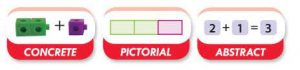
Concrete manipulatives are introduced in combination with models such as Five-Frames and the Hungarian Number Frame to develop number sense. Children continue to use concrete and pictorial representations alongside the abstract throughout school.

3 represented on a Five-Frame |

Hungarian Number Frame showing 7 |
Power Maths
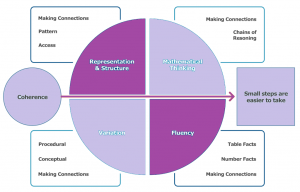
From Y1 – Y6, teachers follow Power Maths which is underpinned by the ‘five big ideas’ shown below. Children begin their daily maths lessons responding to feedback from the previous lesson and engage in retrieval practice before being introduced to new learning within a context.
Children are given opportunity to use manipulatives to model their mathematical thinking and explain their reasoning through a back and forth approach using the correct mathematical vocabulary. An “I do, we do, you do” approach is followed so children become confident understanding mathematical concepts and applying this knowledge.
Fluency
At SMC, we allow an additional 15 minutes each day to the teaching of fluency. We know that developing children’s efficiency, accuracy and flexibility reduces their mathematical anxiety.
Time is allocated within the fluency session to improve the automaticity of multiplication and division facts.