SMC Autumn Retreat 2024
Dignity of ourselves
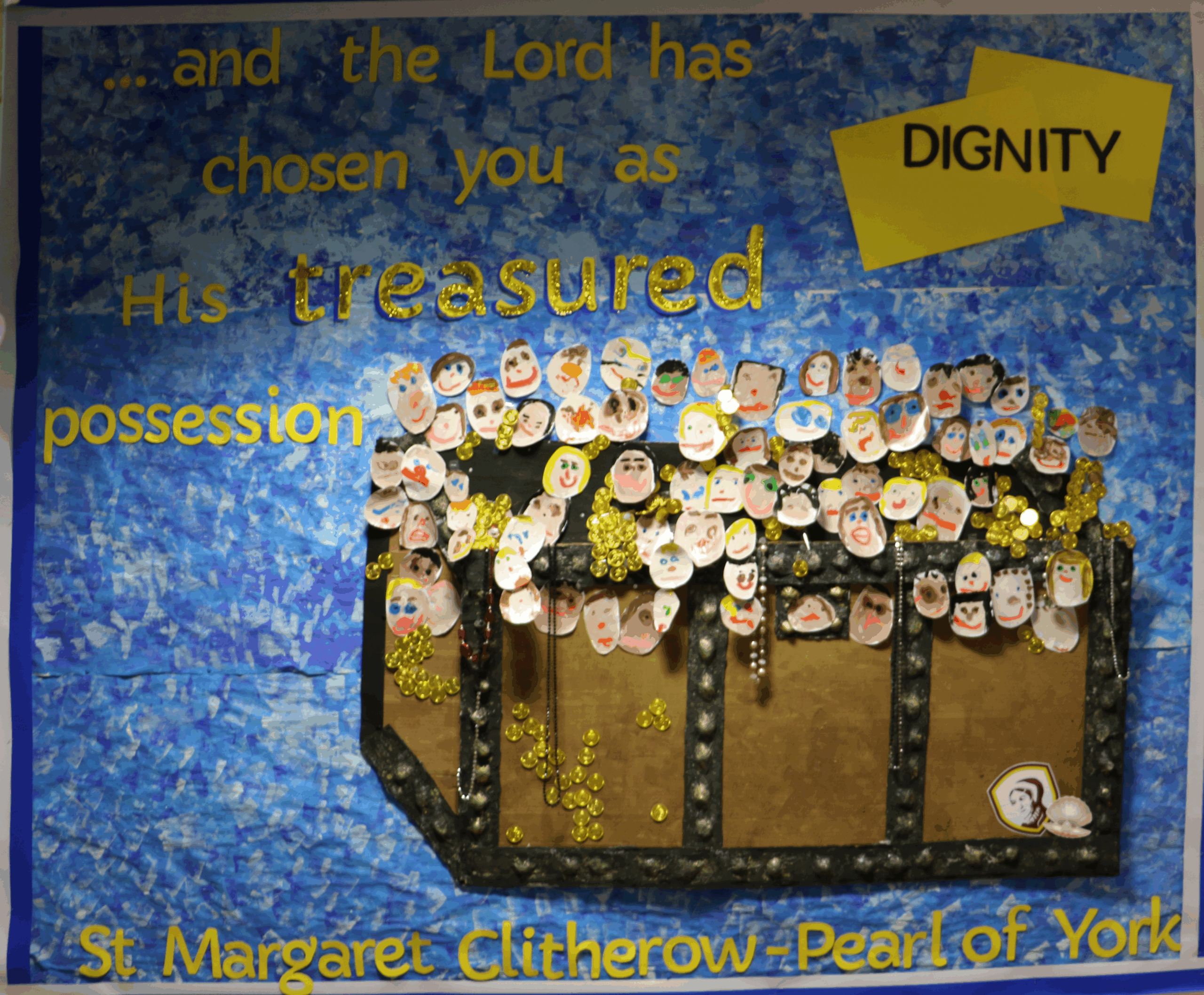
“The LORD your God has chosen you to be a people for his treasured possession, out of all the peoples.”
Deuteronomy 7:6
In EYFS, the focus of our retreat day was ‘Dignity of Ourselves.’ We looked at how we are all God’s treasures. We are all precious and valued by God and are all equally important.
We talked about precious things and lots of children said that gold, silver and jewels were all precious.
We used the idea of a treasure chest and all painted pictures of ourselves to go into the treasure chest.
The children in Reception worked together to help create a treasure chest for our display.
We then used the ideas of St Margaret Clitherow, our school Saint. We talked about how she is precious. We learnt that she was known as the Pearl of York and that a pearl is another precious stone. We added her to the treasure chest along with all of the children in EYFS.
We have also been learning the CST song from the CAFOD website. We are getting really good at this!
Care for God’s Creation
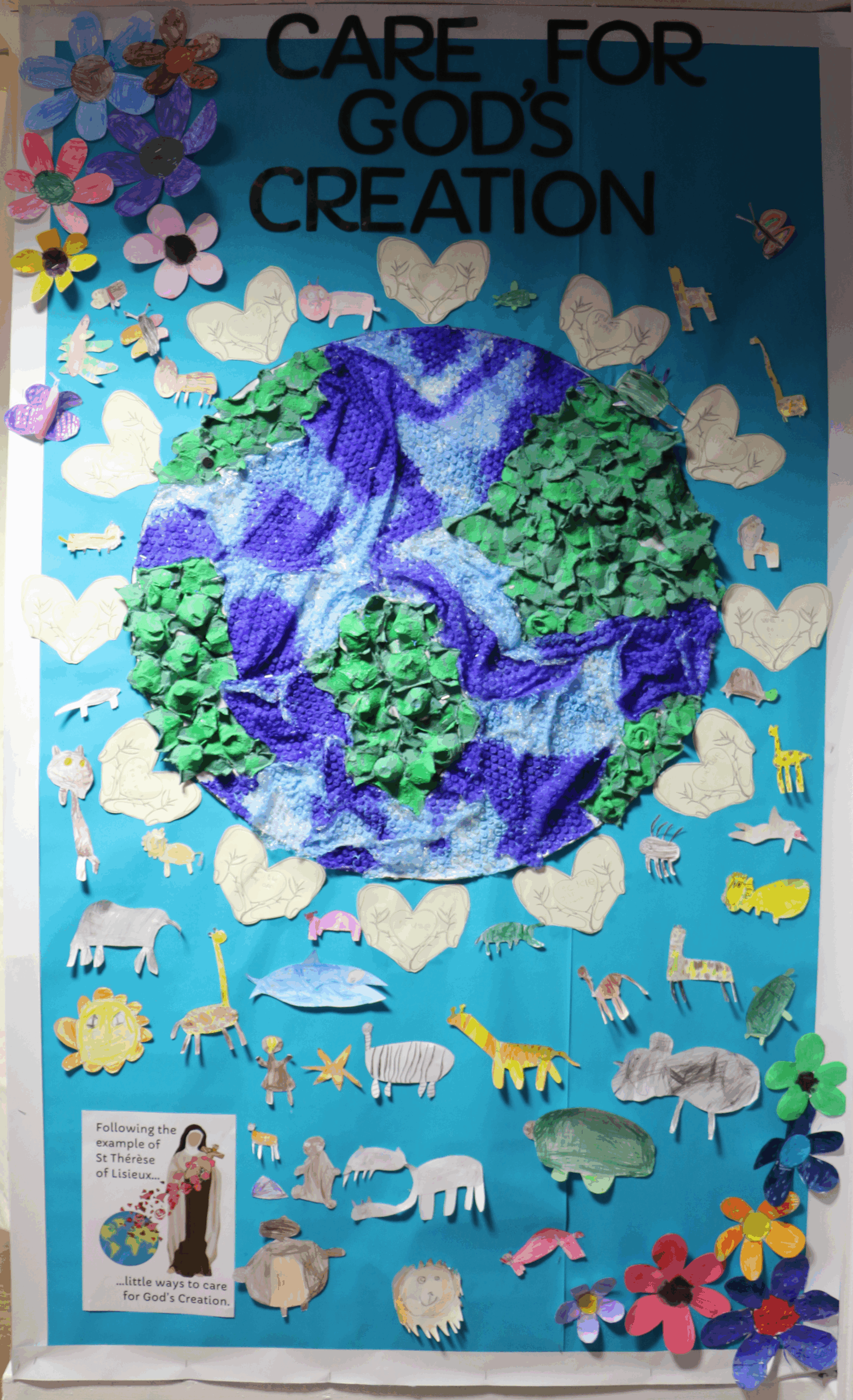
“All of us can cooperate as instruments of God for the care of creation”
(Laudato Si, #14)
In Year 1, the focus of our retreat day was ‘Caring for God’s Creation’.
We began by learning about the encyclical (open) letter written by Pope Francis, Laudato Si’. In the letter, he tells of the damage being caused to our world by those who have been entrusted to care for it – humans. He also identifies that it is our shared responsibility to help care for our Common Home, as it is a gift from God. We discussed the issues of pollution from litter and the wasting of precious resources such as water and trees, and learnt about the effects of these on animals and the environment.
We then learnt that Pope Francis was inspired by St Therese of Lisieux, sometimes known as ‘The Little Flower’. As a young girl, Therese decided to dedicate her life to God, and to always try to find ways to help others and to love God. She recognised that we can’t always do huge things ourselves, but we can all do ‘small things with great love’.
As a class, we discussed what ‘small things’ we can all do to help our world and to care for God’s wonderful creations. We worked together to make images of God’s creations, and to write examples of things that we can all do – saving water, planting more trees, not wasting electricity, putting rubbish in the bin safely, and recycling what we can.
Through our display, we hope to encourage others to demonstrate their own ‘little ways’ of caring for God’s creations.
Peace
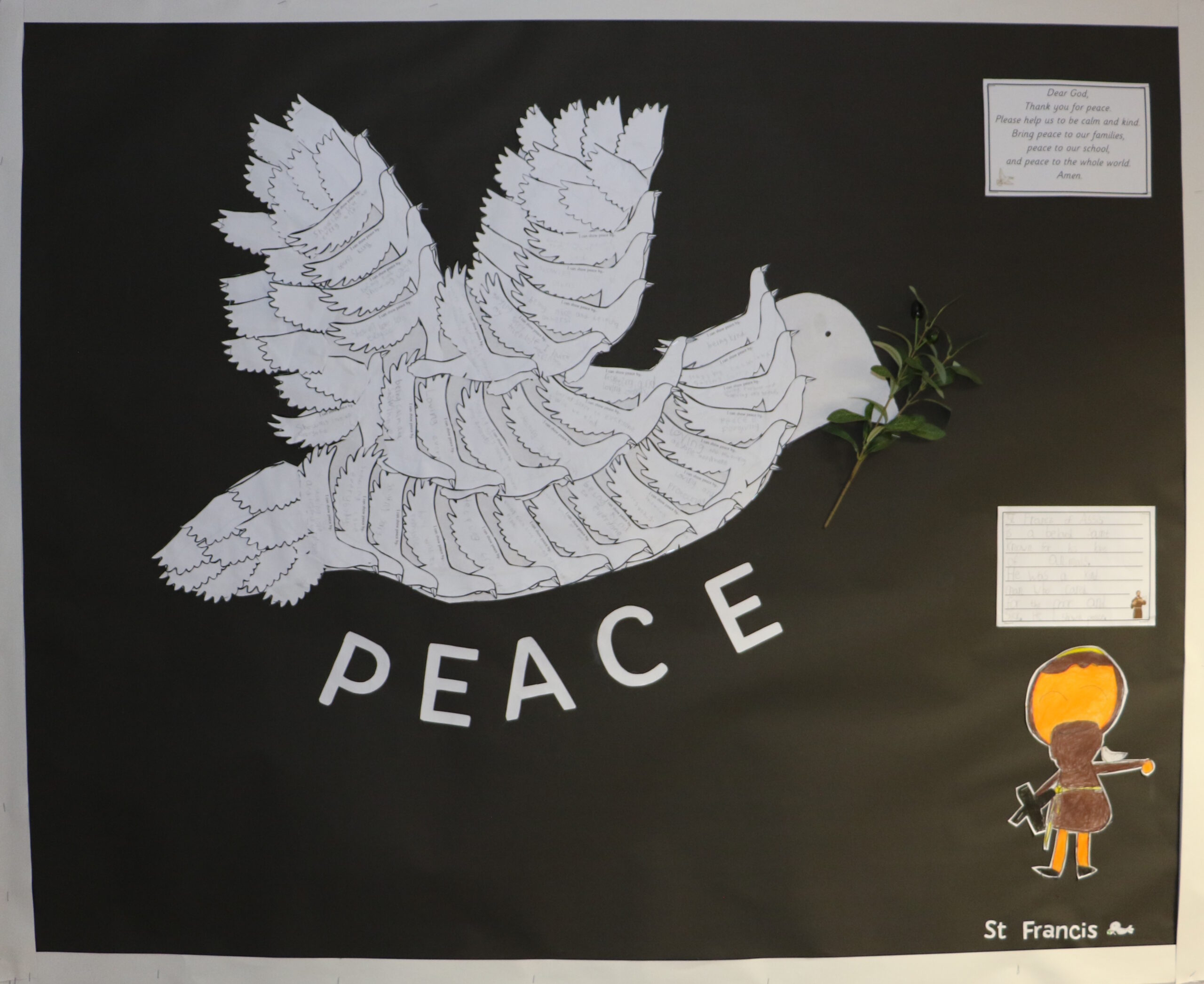
As part of our retreat day in Year 2, we focused on Saint Francis of Assis and his works of Peace.
We discovered that St Francis of Assisi was a kind and gentle man who lived over 800 years ago. He believed that to follow Jesus, people should live simply, love everyone, and care for all of God’s creation. He called animals and nature his brothers and sisters, showing that all living things are connected.
We also learned that Francis taught that real peace starts in our hearts. He often said “Peace and Good” to everyone he met. He showed that peace comes from forgiveness, kindness, and respect, not from fighting or trying to be more powerful than others.
St Francis also helped people make peace in their towns and reminded his followers to be gentle, humble, and caring. If one of us makes a peaceful action, led by the Holy Spirit, then others will too. This will lead to unity. This idea formed our display idea.
Each of the children were asked to think of how they could make peace in the world and filled in a dove of their own. This then was pieced together to form one whole dove, the symbol of The Spirit and peace. If we all work to make peace, then we will have a united world of peace.
The Catholic Church teaches that peace is not a weak choice, it’s the strongest one. It takes strength to forgive, to say sorry, and to choose love over hate. St Francis lived this every day. He reminds us that being peaceful doesn’t mean doing nothing, it means working hard to bring people together, care for others, and look after the world God made.
Saint Francis of Assisi, pray for us.
Common Good
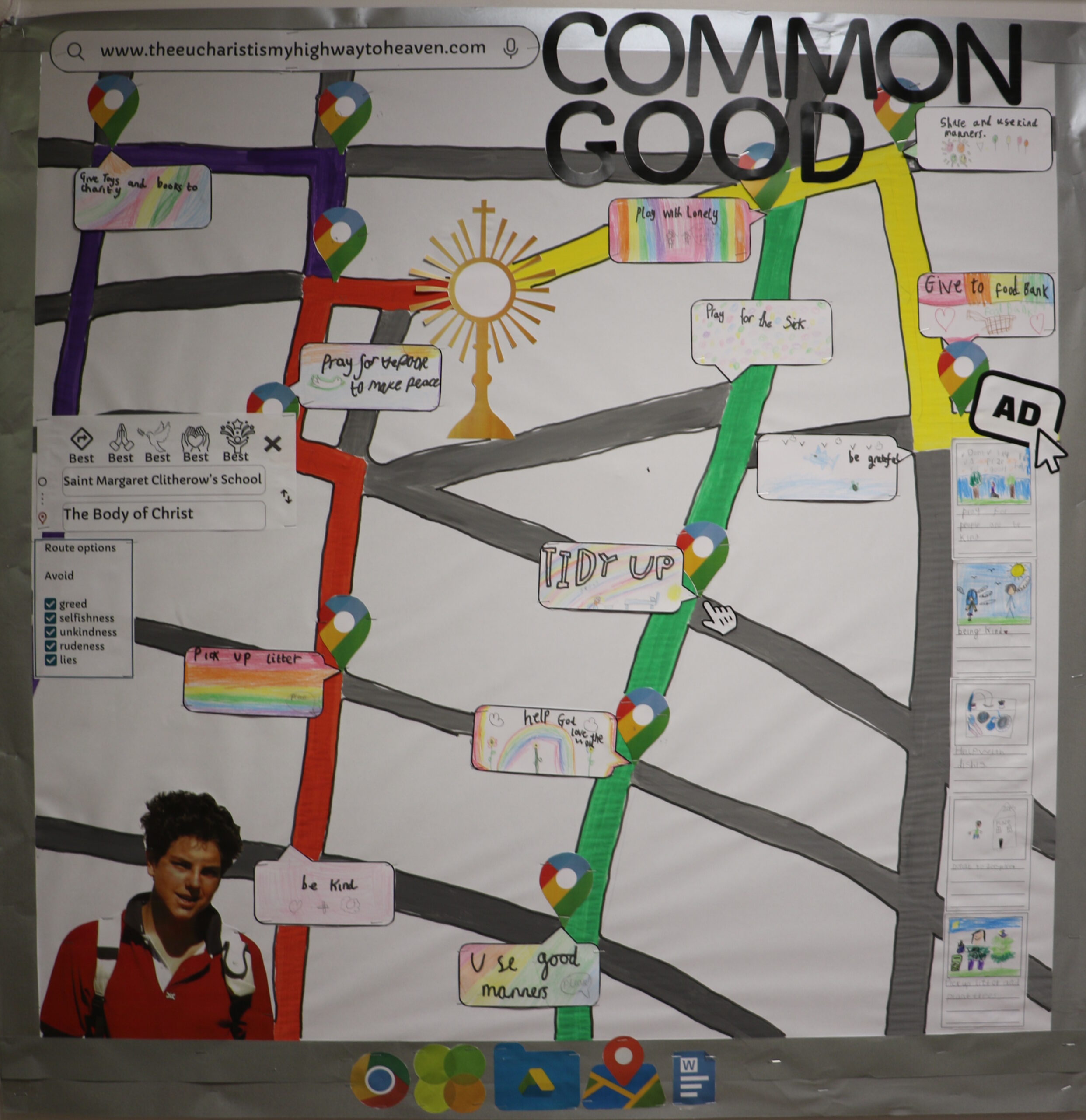
“The Eucharist is my highway to Heaven.”
On our retreat day in year 3, we explored Saint Carlo Acutis and his quote, “The Eucharist is my highway to Heaven.”
We discussed that he believed that receiving the Eucharist, when we take Holy Communion at Mass, is the most special way to be close to Jesus. Carlo believed that Jesus is truly present in the Eucharist, and that every time we receive Him, we are filled with His love and strength to do good in the world.
We also learned that The Eucharist doesn’t just bring us closer to Jesus, it also brings us closer to each other. When we receive the Eucharist, we become part of something much bigger than ourselves: the Universal Church. This means that people all over the world, from different countries, languages, and cultures, are all joined together as one family in Jesus. No matter where we come from, when we share in the Eucharist, we are connected as the Body of Christ. This reminds us that everyone is important, loved, and has a place in God’s family.
Because the Eucharist unites us, it also calls us to live for the common good — to think not just about ourselves, but about others too. Living for the common good means helping to make the world a kinder, fairer, and more loving place for everyone. Jesus gives us His love in the Eucharist so that we can share that love with others.
We can do this in many simple but powerful ways:
- Being kind and respectful to everyone, even when it’s hard.
- Helping people in need, like donating food, clothes, or time to help the poor or lonely.
- Caring for God’s creation, by recycling, saving water, and protecting animals and nature.
- Standing up for what is right, like including people who are left out or speaking kindly instead of spreading gossip.
- Forgiving others when they hurt us, just as Jesus forgives us.
Saint Carlo was known for his love for technology to create websites that shared the beauty of the Catholic faith with the world. Carlo cared about others and treated everyone with kindness, showing that being part of the Universal Church means using our gifts to help others.
To reflect this idea, our display uses the style of “Google Maps” – the highway. The different coloured routes work towards The Eucharist in the monstrance – to represent the body of Christ and the universal Church being united in it. On the different coloured routes there are “points of interest”. These points of interest are things which we need to do on the way towards the Body of Christ, working for the common good. We also have at the side of the display “avoid” stations which are a feature of Google Maps. Things to avoid, such as greed, selfishness and unkindness, were things which we did not want to go towards as they did not work for the common good.
Like Saint Carlo, we can follow his example by letting the Eucharist guide us — just like a highway — toward Heaven. When we live in unity as the Body of Christ and work for the common good, we make the world more like the loving place God wants it to be.
Saint Carlo Acutis, pray for us.
Option for the Poor
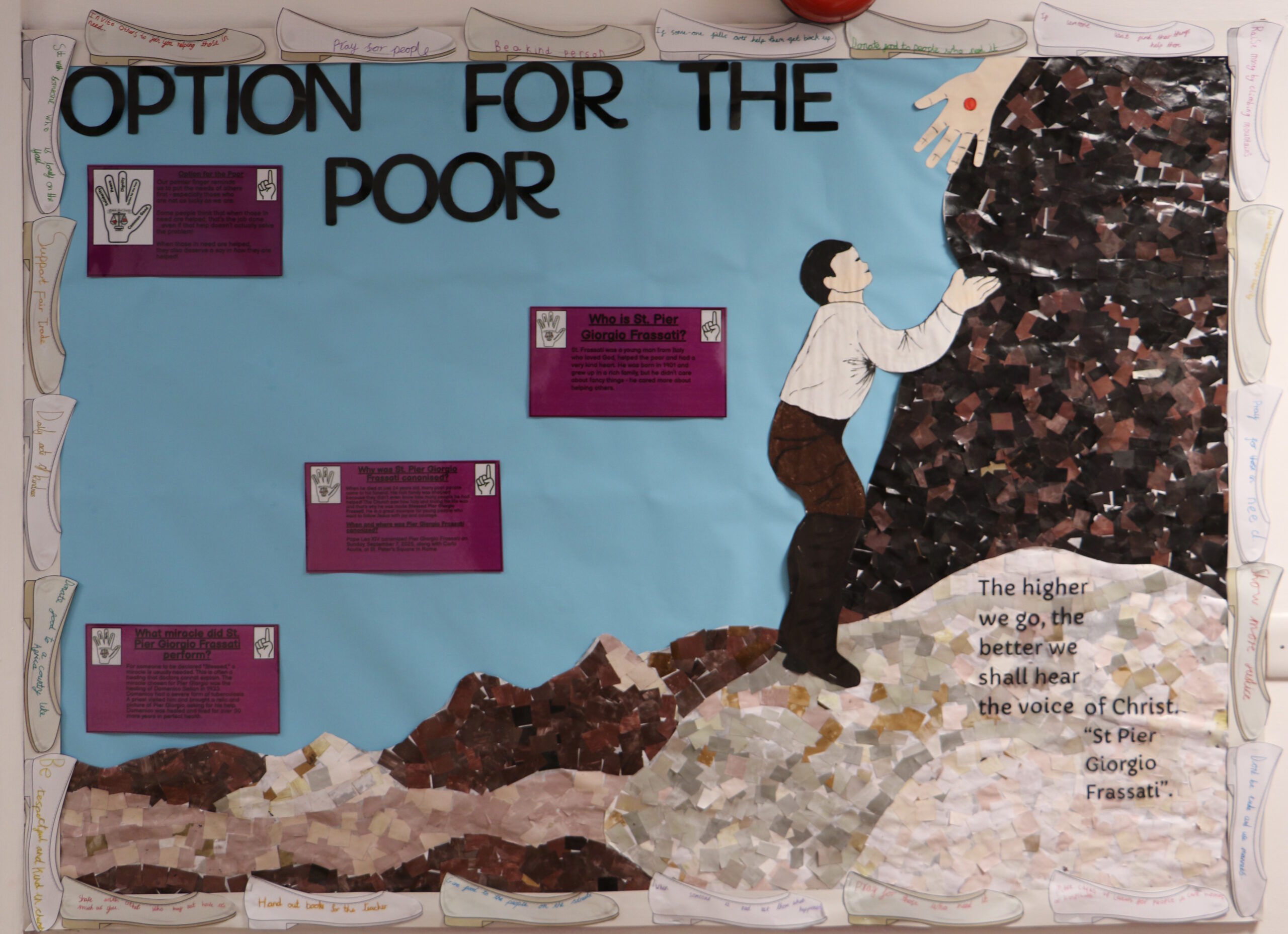
“The higher we go, the better we shall hear the voice of Christ.”
On our retreat day in year 4, we explored St. Pier Giorgio Frassati and his quote, “The higher we go, the better we shall hear the voice of Christ.”
The children learned that St. Pier Giorgio Frassati was an Italian Catholic known for his deep faith, athletic pursuits, and radical generosity to the poor and suffering. He spent his short life combating social injustice and serving Christ in the marginalized, living a life of virtue and athleticism, and advocating for social reform. He is considered a patron saint for young people, students, and athletes, and his personal motto, “Verso l’Alto” (To the heights), inspires many.
St. Pier enjoyed climbing mountains with his friends so the children used this knowledge to create an image that included St. Pier and a mountain. The display also depicts an image of Christ reaching out his hand towards St. Pier to aid him on his climb. These images symbolise us being like Saint Pier, with Christ helping us when things are hard.
St. Pier demonstrated profound generosity by giving away his possessions, including his bus fare and his own shoes to those in need. St. Pier would carry bread around in his backpack in case he came across anyone who was in need of food. On reflection, of St. Pier’s actions, the children wrote suggestions on images of shoes of how we can help those in need. Some of the suggestions for living out our mission of ‘Option for the Poor’ are;
- Small acts of kindness- smiling at others, saying hello and using good manners, holding the door open for those who are carrying many things, assisting someone with their bags.
- Raising money for charity such as CAFOD.
- Donating food to the local foodbank.
- Donating toys and clothing to charity shops.
- Buying food for someone homeless outside a shop.
- Praying for those who are poorly.
- Making and sending cards/letters to people in care homes or hospitals.
- Visiting the lonely in care homes and playing a game or reading to them.
St. Pier Frassati never sought praise or glory for his actions. He was a humble young man who lived out his mission from God with only God watching. He reminds us that we help others because we are made in the image a likeness of God, not for prizes and praise.
Dignity of all
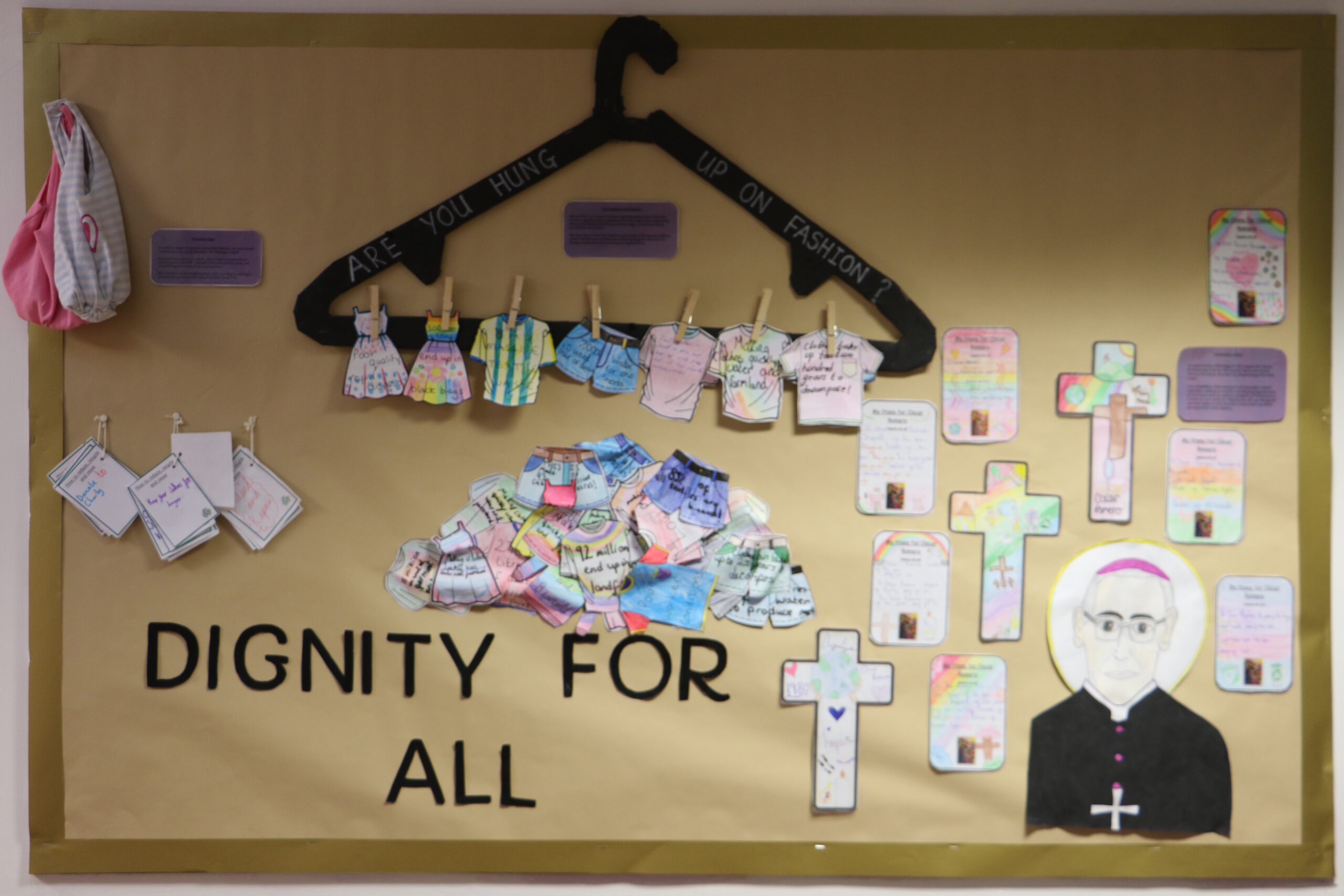
In year 5, we recognised that being created in God’s image and likeness means that we have dignity and that no one can take this dignity away.
Together, we discussed how in order to maintain dignity for all, we therefore must cherish and respect every human person, seeing the image of God within them no matter what.
We looked at the work of St. Oscar Romero. He was an Archbishop from El Salvador who campaigned for the rights of poor people and spoke out against violence during El Salvador’s civil conflict.
Oscar Romero understood that everyone was made in the image and likeness of God. He wanted the poor people to have the same rights as the power hungry and this made him unpopular with dangerous people. He never wavered in his determination to make the world a better place. Oscar Romero united the Church to help the suffering, fight against injustice and inspired global action. Sadly, he was assassinated in 1980.
In order to celebrate and acknowledge the work of St Oscar Romero, we wrote litanies (a form of traditional prayer that includes repeating sentences) and designed Romero crosses (sometimes known as El Salvador crosses.
We also looked at ways that we could respect human dignity, such as:
- Considering other people’s needs
- Praying for them
- Upholding their rights
- Acting in solidarity
- Caring for the Earth
We carried out research on the subject of Fast fashion and how it severely compromises human dignity by subjecting workers, disproportionately young women, to inhumane working conditions like low wages, excessive hours, and unsafe workplaces, all to produce cheap clothing that fuels overconsumption. This exploitation occurs because the fast fashion business model prioritizes profit and rapid production over worker welfare and human rights, often occurring in countries with lax enforcement of labor laws, creating a cycle of poverty and violence against workers.
We created a display to educate others about Fast Fashion; its detrimental effect on Human Dignity and ways we can minimise these effects. Recycling and re-using our pre-loved clothing was one suggestion we took on board – designing and creating our very own bags from something that was very likely destined to end up in a landfill!
Solidarity
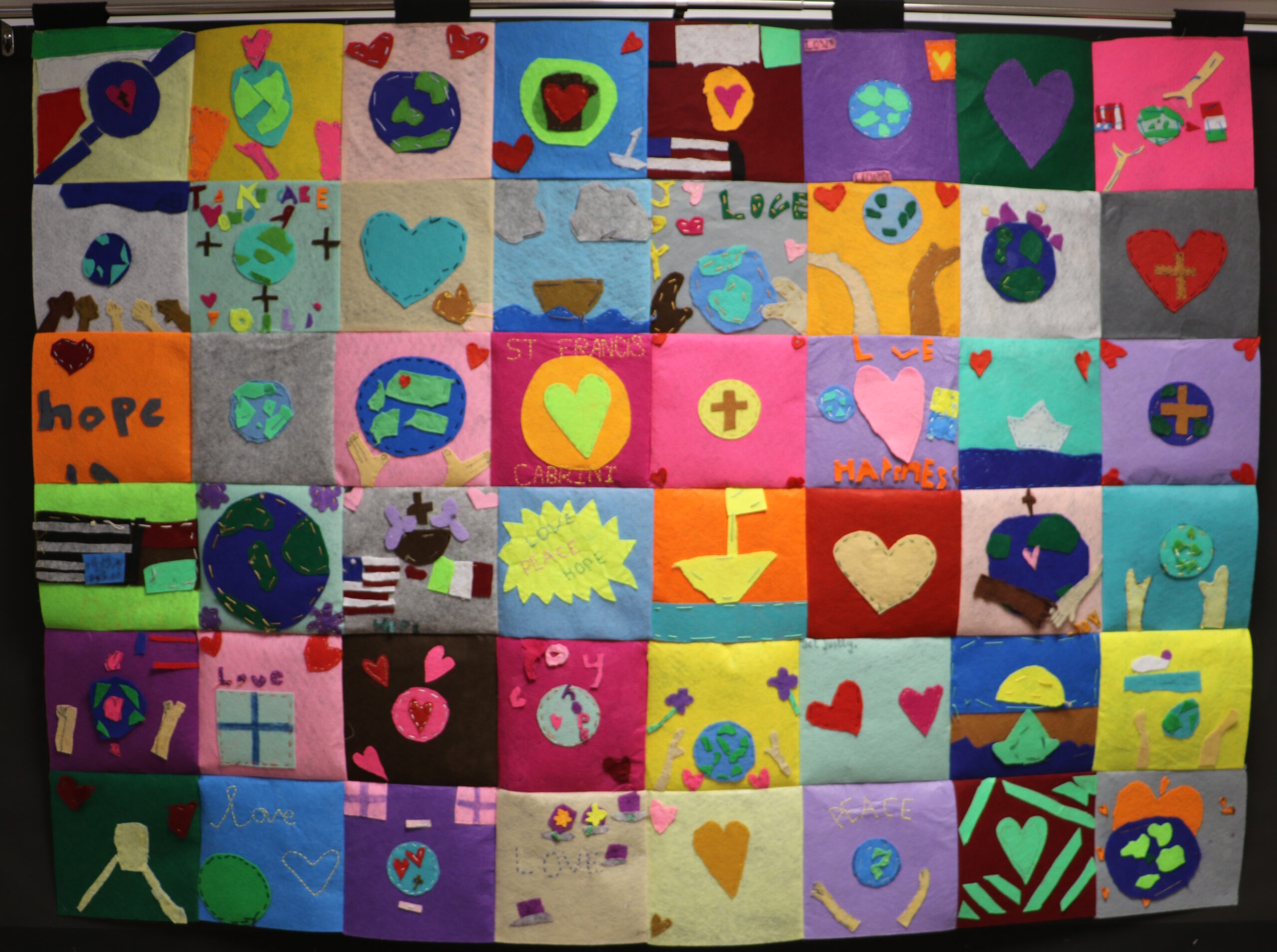
‘Christ asks us – welcome our brother and sister, migrant and refugee with arms wide open’.
Pope Francis
In Year 6, as an inspiration for standing in Solidarity, we focused on St Frances Xavier Cabrini who is the Patron Saint of Immigrants who helped those in need when they moved to America from Italy, to flee poverty. We learnt that there is a difference between a migrant & refugee. A migrant is someone who chooses to move to another country. A refugee is someone who has to move to another country because*+c they aren’t safe in their own country.
During our Workers of Peace and Justice retreat day, we went on a journey to simulate the experiences of a refugee, thinking about the hard choices and material & spiritual losses they have.
Throughout the day we reflected on how St Frances Cabrini can inspire us all to be a worker of peace and justice. When she was younger, she made paper boats and filled them with flowers to symbolise sending out missionaries. We have made boats filled with words that remind us that we too can be a missionary and we have a choice to stand in solidarity with all of our brothers and sisters.