At SMC, we begin the teaching of reading in Nursery by preparing the children to access phonics teaching. Within the first two weeks of Reception, the children make a strong start in their phonics journey, in line with structures and approaches from the Ruth Miskin Read, Write Inc. programme. It teaches children to read accurately, fluently and develop their understanding of texts, to support their access to reading across the curriculum and to allow them to foster a love of reading.
Nursery Phonics Preparation
Within Nursery, phonics teaching concentrates on developing children’s speaking and listening skills. Activities are divided into seven aspects, including environmental sounds, instrumental sounds, body sounds, rhythm and rhyme, alliteration, voice sounds and finally oral blending and segmenting.

Read Write Inc.
Children join their small Read Write Inc. group every morning 9:05 – 9:40am. Teachers and learning assistants teach children to read a grapheme each day. During the focused reading session, children:
- Explore and learn a new grapheme, orally segmenting and blending words containing the phoneme before seeing the corresponding grapheme.
- Review previously taught sounds, and words containing these sounds, to develop fluency.
- Read real and nonsense words with the new grapheme and previously taught sounds – spotting ‘special friends’ within the words to help their fluency!
- Apply their knowledge by reading lively phonic books, which are closely matched to their increasing knowledge of phonics.
- Answer questions about the text to show that they comprehend it.
- Practise reading ‘common exception words’ (words that can’t be ‘sounded out’).
Children are assessed every half-term and grouped according to their phonic ability and fluency in reading. To prevent gaps in phonic knowledge, we have established a ‘keep up, not catch up’ approach to phonics intervention. Those children who are finding it difficult to blend, recognise grapheme-phoneme correspondence or read fluently receive Read, Write Inc. Fast Track Tutoring daily. Highly-trained staff deliver this intervention in line with our phonics programme and frequent assessment ensures they are learning sounds which they need to know, in order to make progress.
How to pronounce the sounds: Information for Parents: How to say the sounds
Teaching sequence
Our specialist phonics teachers engage in practice sessions to become experts in the teaching of Read, Write Inc. This ensures that the teaching is consistent and becomes a routine for both staff and pupils. Staff have a range of resources and support to use consistent phrasing and teaching points in all lessons.
Resources
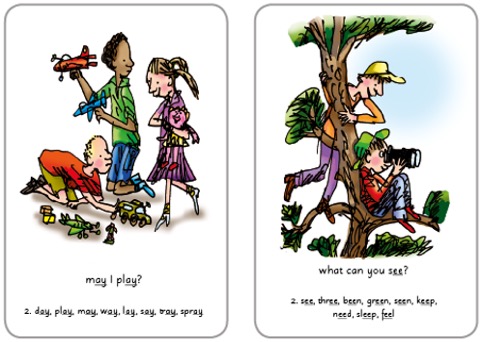
Picture cards: Each sound has a picture and phrase to help the children remember the sound.
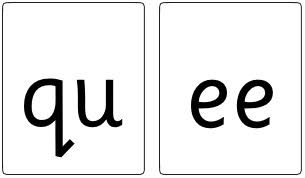
Grapheme cards: Each sound has a corresponding grapheme, which allows children to read words.
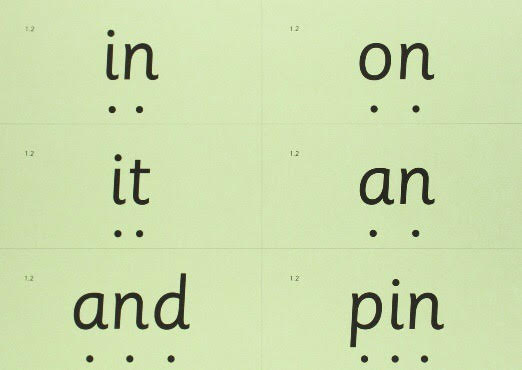
Green words: Words containing new and previously taught sounds, which the children will read fluently. The children are shown some with ‘sound buttons’ on and some without.
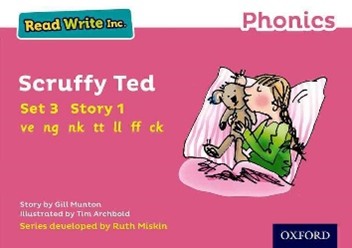
Story books: In school, children are given the opportunity to read and re-read stories and books which are closely matched to their phonic ability. At home, children are given the opportunity to re-read their in-school story book and a mirroring ‘Book Bag Book’, to build further fluency with sounds they know in a range of words.
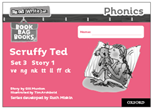
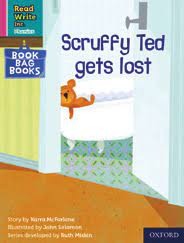
Book Bag Books: Children are then encouraged to take home a Book Bag Book. This book builds upon the ideas and many of the words in the Storybook he or she has just read.
Year 1 Phonics Screening
In June, every child in Year 1 is required to take a ‘phonics screening check’. Those children who do not pass, will retake the test in Year 2.
How does the check work?
- Children read 40 words aloud with a familiar adult
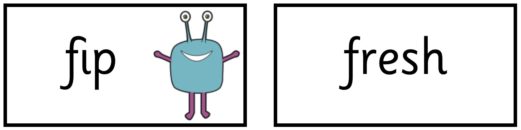
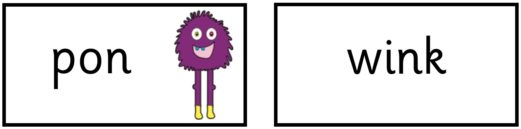
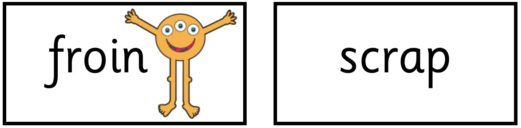
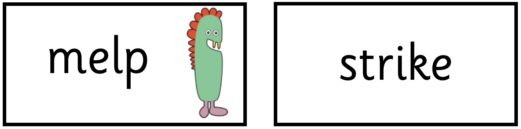
- 20 of these words are real and may be familiar, while other words are ‘nonsense’.
Here are some examples of the real and nonsense words they might read:
Glossary of terms
- Grapheme – The way a sound is written. e.g. ay (as in pay) and ai (as in main) are the same sound but a different grapheme.
- Phoneme – A sound.
- Oral blending – The adult may ‘sound out’ c-a-t for the child to hear and say the word ‘cat’.
- Oral segmenting – The adult may ask the child to ‘sound out’ the word dog and the child would say ‘d-o-g’.
- Fred Talk – sounding out the word before reading (blending).
- Special friends – sounds written with more than one letter,
eg: sh, ng, qu, ch, ay, ee. - Speed Sounds – the individual sounds that make up words.
Miss Westwood ~ Phonics Lead